Showing posts with label emergency preparation. Show all posts

Tuesday, August 31, 2021

Please let what's happening in New Orleans spur you to get your own emergency kit together!

Things you really need:

Canned and bagged food to last a week. And a can opener that doesn't need electricity or all cans need pop tops.

Water to last three weeks. You don't need to buy commercial bottled water. I save milk cartons, wash them, and fill them with tap water. I have 25 bottles lined up in the garage in time order, and recycle the oldest as I add a new one. Or you can empty them and re-fill on your birthday every year.

Cash to last a while. ATMs might not work for several days.

A crank or solar (or combination) cell phone charger.  

Never let your gas tank in your car get under 1/2 (thanks Dad for teaching me this!), and if you see a disaster headed your way (only hurricanes are so helpful in this way), fill up your tank as soon as the NHC tells you it's headed your way. Do not assume a Cat 1 hurricane will stay that low, not with rapid intensification the way it's been happening the past decade. 

Gas for anything else you have that requires it (chainsaw, generator).

A few big packages of hand wipes in case you need to bathe with them. Hurricanes and earthquakes can result in no water at all coming to you.

Paper plates and napkins. Even if you usually are more "green" than that, you get a pass during an emergency. In a flood situation when water isn't safe to wash dishes in, or an earthquake that leaves you without water, you'll be happy you have them. Paper is better than plastic if you have a safe place to burn it, in case trash pick up doesn't happen for a week. (I have a burn ring at my house.) 

Sufficient drugs for a month, prescription or over the counter. Masks for disease and dust reasons. And a decent first aid kit.

Photos you've taken of important documents (birth certificates, insurance, proof you rent or own your home, driver's license, etc) available on your phone and in the cloud.

If you have kids, books and cards and puzzles and other non-electrical entertainments.

Batteries for anything you have that requires them. I use rechargeables, and I always have eight AA and AAA batteries ready to go.

Things you might want:

If you only have an electric stove, a gas grill to cook with. If you don't have power after two days, you may be grilling a lot of food at once and having the neighbors over.

A bug-out bag. Mine, a hat, and sturdy boots are hanging right by my car in the garage. I can grab them and go, and they have plenty. Sturdy boots are crucial because so many disasters leave you with glass, nails, or other hazardous items to walk over. In California, they tell you to keep your boots and a hard hat or bike helmet right under your bed. Good advice! Pre-packed bug-out bags are useful if you need to go to a shelter.

A generator, but only if you understand how to use it safely. I have two relatives with whole-house generators, and I have one in my RV (which also serves as the biggest bug-out bag ever.)

A solar shower. I use Advanced Element's, and I used it twice a week for several years without it ever springing a leak. 

Small survival gadgets like a Swiss Army Knife or a multi-tool, a water filter, and a magnesium fire starter (mine has a compass on the end of it). I keep all these in my bug-out bag (which is a backpack), along with toilet paper, a small first aid kit, two bandanas, extra socks, a fleece vest, two "space blankets," plastic bags, a paperback book to read, and a tiny fishing kit in a film cannister).

I also own a rechargeable fan that last four hours on low. There are some that operate off a small solar panel. Think how people in New Orleans would love one of those this week. It's not A/C, spray yourself with water and stand in front of it, and it's better than nothing.

And please, when you hear the words "mandatory evacuation," evacuate!

Most nations and many states and provinces have websites on emergency preparation. In the US, it's ready.gov.

Sunday, August 27, 2017

Fun ways to prepare for collapse

Though I’m very skeptical about a rapid, catastrophic collapse of civilization, I do think things will be changing over the rest of the century. Perhaps you have children, and you’d like to help them be positioned best for a shift over their lifetimes.


home canned food Library of Congress image

First of all, I think these shifts will probably be slow enough that they’ll have time to adjust on their own. But a few skills learned young can serve for a lifetime. You can easily imagine a forty-five year old kid of yours saying, “Yeah, we had hens for a couple of years when I was a kid. What was that Mom said...?”

Hunter-gatherer skills. Teach your kids or grandkids to fish, hunt, shoot a bow, throw a spear, or identify and collect edible plants of your region, or all of these.

Farming skills. If you have a farm, great. (And I’m jealous.) If not, have as big a farm as you can manage, even if that means ten potted plants on the patio, which is what I have right now. You’ll learn about your region, the insects that will be a problem, the growing season, the local soil and what it needs. Involving your children and grandchildren will help them learn how to grow their own food.

If you can have hens where you live, think about doing that for at least a year or two. A dairy cow a possibility? Cool, though few of us could do that. Again, just a couple of years of doing this with your kids can teach lessons that will last many years.
 
Home skills: The more cooking, woodworking, basic mechanicals, plumbing, food preserving that you can learn and teach, the better. Have angora rabbits and spin your own yarn, then knit or crochet it into clothing? Make the family's old t-shirts into braided rugs and jackets? You get a gold star from me! You say you brew your own beer? Wonderful! Know blacksmithing? Wow, that one's really impressive.


All of this can be fun. It’s not much extra effort than what you likely do already around home and yard, it’s far healthier of a family activity than staring at a game console or TV all the time, and you might meet your next dear friend by getting out and learning some of these skills.

I can imagine a future where we live an agrarian lifestyle again--or our descendants will--but if I'm wrong, you've had some fun, so you haven't even wasted time.


You can hoard supplies for the end time, but supplies can be stolen or go bad or be lost in a flood. Knowledge is yours forever. Hoard knowledge.

Wednesday, October 19, 2016

Shake out drill

Tomorrow is the GREAT SHAKE OUT earthquake drill, worldwide, at 10:20 local time. Drop. Cover. Hold On. If everyone did these simple things when the ground under their feet began to shake, many lives would be saved every year.

Bonus instruction: don't run outside in a city street to get killed by falling glass and gargoyles.


Sunday, September 4, 2016

September is Preparedness Month

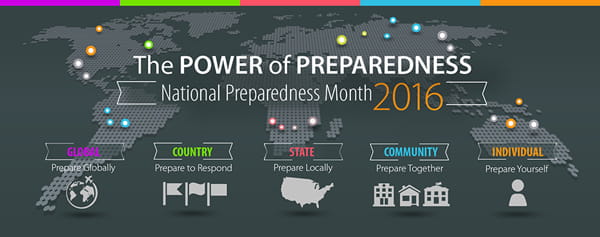
Here in the US, September is the month we're supposed to review our emergency plans, restock our food and water supply, and get ready for the coming year of natural disaster and power outages that might come our way.


I’m not much of a prepper. I do have a bug-out bag in my car trunk, and I do have 25 pounds of rice in my cupboard. But the latter came from my friend Ron and the former comes from my being a proponent of being prepared for realistic emergencies.

Not just preppers but everyone needs to be prepared for the sort of disaster that is most likely to happen wherever they live. Don’t worry about the end of the world; worry about the end of your stable world! Earthquakes, wildfires, tornados, hurricanes, sub-zero temperatures with electricity loss, house fires, floods: these are the likely events that could make your life uncomfortable or hellish at some point in the future.

For any emergency, you should have a three-day supply of water, food (and pet food) for every member of your family, cash, life-saving medications, and a change of clothes. Duct tape and a couple of bandanas are good additions, too, with many possible uses. A spare leash for each pet. Even six-year-old kids can have the special emergency backpack in their closet with a favorite old toy stuffed inside, ready to go at a moment’s notice if need be. A small first aid kit, which I hope you won’t need, is a good addition to one of the adult’s backpacks.

Take photos of your insurance papers, birth certificates, family phone numbers (since cell phones store those for us, we don’t remember these any more, do we?) and other crucial papers; upload them to the cloud, in an account you won’t forget the password of when you’re panicked. Make sure there are pictures of the pets in there, too, in case you get separated in a dire emergency and need to make lost pet posters. Even if your phone runs out of charge, usually in serious emergencies, you can find somewhere to get online. (libraries, special Red Cross facilities, cafes.)

The US government has done a terrific job of putting up emergency preparation information. (And anyone can look at it, no matter your nationality.) Ready.gov September is a month we’re to think of this, and if you haven’t freshened the water and food in your supplies you collected last time I nagged you about this, it’s a good month to do that. (Scroll down and click "emergencypreparedness" among my blog topics for all my posts on this.)

Stay safe.

Sunday, September 20, 2015

Preparedness Month: for children


Most kids will become enthusiastic about the topic of emergency preparedness, and involving them in your plans will help the whole family stay safe, and it will give you a chance to educate your children about natural disasters, weather, and geology.

The ready.gov kids' site here has good information, presented attractively. It tells us to:
  • Make a plan
  • Build a kit
  • Know the facts
  • Get involved 
The site also has a comic-book adventure through several disasters that tests knowledge and was fun for me to play. I even learned something new: that in a wildfire, you should leave your home lights on to help firefighters see the building through thick smoke.

Building an emergency kit can be a fun activity for the whole family. Here's a link to one pdf checklist for suggested supplies. So involve your children and be prepared for the worst...as a family.

Sunday, September 13, 2015

Preparedness Month: 30 Days, 30 Ways


There's a pretty cool preparation game with blog and Facebook page to help people prepare for natural disaster emergencies: 30 Days 30 Ways. Every day, there is a paragraph or two to read and a task to complete. Some tasks are about raising awareness and self-educating, and some are practical about building your emergency kit. I can imagine turning this into a great scouting activity, too.  Again, while this is a site associated with the US government's Preparedness Month, anyone in any nation can take part. Enjoy!

(And to reassure my fans, #amwriting on Gray III, and my stand-alone tornado novel will be revised and published soon after that.)


Sunday, September 6, 2015

Preparedness Month: Floods

In the US, it's National Preparedness month, but my Australian, Canadian, and UK readers, and all, are invited to join us!
Mark Arvette, via Wikimedia Commons
Week 1's focus is floods. I am familiar with these both from growing up along a big river (where I volunteer sandbagged more than once) and from living now in a desert where washes fill very quickly with monsoon-season rainwater. Six inches of moving water can knock down an average-sized person, and children are more vulnerable. Two feet of water can sweep away a car.

Don't risk drowning. Stay out of moving water and wait patiently for it to subside--or turn around and find another route.

While camping next to a stream in a mountain environment might look inviting, during the rainy season or when there are rain clouds in the vicinity, walk up hill to higher ground and camp there.

If you are evacuated from your home for a major flood, please, heed the evacuation order and don't return until the official all-clear has come.

Be safe. Be prepared.


Sunday, August 16, 2015

Half of Americans at risk of earthquakes

A new study in Earthquake Spectra that reminds us of the truth of the seismic hazards map in the US is getting a lot of press coverage, and that's a good thing, in my opinion. Here's one link, and there's another good article at National Geographic.

USGS

Sunday, April 19, 2015

Tornado emergency preparation

In North America, it's tornado season, and it will be for six more months.

Wikipedia Commons

Some reminders on preparation for these killer storms:
  • Make your emergency plan now and discuss it with your family
  • Find your "safe room," the best place in your home to survive a tornado
  • Know where the designated shelter is at work or school
  • Have a contact person and meeting place for your family at least a few miles away from home, should your home be destroyed and the cell phone towers taken down, too, preventing phone calls
  • Prepare your emergency kit: a gallon of water per person and per pet, a battery-operated radio (a NOAA weather radio is ideal), canned food with pop tops and crackers and peanut butter (or equivalent), life-saving medicines, plastic bags for waste, work gloves, and a flashlight. This is the very minimum you should have, and you can google for more information on tornado emergency kits
  • Keep photocopies of driver's licenses, insurance information, birth certificates, and other important information either at a relative's house, in a safety deposit box, or scanned and in the cloud
  • Listen to the broadcast warnings and obey them
  • Don't risk your life getting a video for youtube of a funnel cloud bearing down on you
  • Obey police and fire when they tell you not to enter an area or structure, no matter how panicked you are about loved ones or how curious
  • Don't be a tornado tourist if there's destruction near you. It's rude at best, dangerous to you and others, and places unnecessary strain on first responders who might be saving lives instead of trying to police you
  • If you loot tornado victims, expect to be shot, and prosecuted, and shunned by decent people thereafter

Stay safe!

Monday, October 6, 2014

Shakeout!

Shakeout is a worldwide earthquake drill. At 10:16 local time on 10-16, you pretend there's an earthquake.


If you want to go beyond that, put a pair of hiking boots, with a flashlight tucked into one, and hardhat or bike helmet next to them, and put them under your bed on 10/16. If an earthquake happens at night, it's right there, within easy reach. But if you do the basic drill--at home or the office or school or the public library--and encourage others to as well, it'll take you one minute. I saw this work in 1989 to prevent injuries. No doorways. Don't run outside. Protect yourself from falling debris.

Drop. Cover. Hold on. It's simple!

Sunday, August 24, 2014

The Napa Quake

Best wishes go out to anyone effected by today's earthquake.

Please, everyone, take this is a reminder that you need an earthquake/emergency/bug-out kit! This is true no matter where you live. If it isn't a quake that puts you at risk, it could be a tornado, ice storm, hurricane, or nuclear plant disaster. Everyone needs to be prepared. I'll post more in the coming months on what that kit might include.

An email from a friend asked me if this quake gave me PTSD flashbacks to the Loma Prieta quake, which I experienced. I didn't get PTSD from it--unless you consider housework a trauma. For me, it was merely a big mess to clean up. Yes, I shot out of bed at the bigger aftershocks, but none of that seemed to do me any permanent harm.