My audiobook for the Oil Apocalypse book, Desolated is on sale now.
Click here for Audible.


Hello, fans! I've been writing, but not as Lou Cadle, the past two years. Seven screenplays and five books in other pen names, so definitely working. I continue to have fond memories of the good years as Lou and the connections I made with fans.
I read a terrific book this month that might be of interest to post-apocalyptic readers and writers. It is Nuclear War: A Scenario.

Ms. Jacobsen has done her research, and those of you who read my books know what a fanatic I am about that. It's all in the details, and these details are fascinating. She managed to get interviews with a lot of people who know a heck of a lot of classified details, and you learn more than you might have thought was possible.
And quite a bit of that will terrify you.
In her scenario, North Korea launches just two nukes at the USA. Second by second, she details what is happening. Decisions that decide the fates of you, me, and millions of creatures on the planet have to be made quickly. Six minutes in, which takes over a hundred pages to narrate, the fate of us all is decided. Once the launch button is pushed, there is no recalling a missile.
That's a little spoiler-y, and sorry, but it doesn't turn out well. (Did we ever think it would?)
If you read non-fiction, if you like thinking through the end times scenarios, or if you're a big fan of military non-fiction, you'll probably like this one.
I've long had an urge to try writing screenplays, so that's this year's project.
I've adapted one of my pen name books into a limited series and wrote two original screenplays.
While the chances of making it as a screenwriter are very small, I'm completely enjoying the challenge.
I also got a new idea for a post-apocalyptic tale that doesn't feel derivative or repetitive to me. If I still feel this positive about it, I'll start on it later this year.
until 24 February, Book 4 of the Oil Apocalypse series is on sale as audiobook.
Click here:
Link here: https://www.audiobooks.com/

Advice to would-be writers
All of the good advice that I know has been said already, hundreds of times, and published in a number of how-to-write books. Still, I’ve recently been asked to give talks at a local writer’s group, and it’s made me think about what advice I would give in general at this point, looking back over almost 40 years of writing and 35 years of being published. I've said a lot of this before, I'm sure.
1) Only take advice from the successful. It’s not that the unsuccessful might not have read a few good bits of advice and be able to parrot them, but why take the chance they got it right? (I laugh whenever I think of an amateur writer who was so sure he knew the “rule” – which isn’t one – about avoiding adverbs, and then circled every word that ended in -ly, like “family” and “only,” which are not adverbs at all!) There are plenty of how-to books out there by the likes of King, Evanovich, and so on. Go read those.
1-a) you could argue that I’m not successful, and I wouldn’t argue against you. I’m more successful by counting numbers of readers than most writers I’ve met over the years, but no, I’m not King or Evanovich or anywhere near that. So take this one bit of advice from me, and then go listen to them for the rest of your advice. It’s what I did as a young writer. I read every how-to book in the library and then started buying more. For self-publishing, read how-to books on the business by people who have books in the top 500 pretty often. You can safely ignore the rest of us.
2) John MacDonald, the mystery writer, is the first person credited with saying “you have to write a million practice words before you can write a good book.” He’s right. Don’t fret and revise a whole lot at first. Write a book, finish it, put it aside (no, sorry, you’re not likely the exception and it’ll probably suck, so set it aside for now), and write the next. (No, sorry again, writing plans and character sheets and drawing maps is not “writing a book.” That’s delaying the writing of a book. Write scenes. Action. Dialog.) After you’ve finished four or five books, start revising/rewriting the best one or two. Maybe one about then will be good enough to sell (to an agent, publisher, or if self-published to an audience.) After a few finished second drafts, go back and look at that first book. Ouch, it sucks, doesn’t it? Glad you didn’t submit or publish it? I bet you are. :D
3) Pay for a couple of workshops with good writers whose work you know and admire, and who have a good reputation as clear teachers, and get feedback from them on your best work.
3-a) Amateur critique groups are of limited use. Where you can learn by joining them is how to analyze how others’ stories went wrong. That’ll teach you not to do that. What you hear about your own story/chapters isn’t going to be all that useful (refer back to point 1). I’d never stay in one for more than six months. You’ll learn what you need to know by then. A writers’ support group is another matter, where you trade information on markets, report how much you’ve written this past week, and cheer on others’ successes. That’s fine. Just don’t fall into the critique trap. Let editors and audiences be your critiquers—they’ll like it, or they won’t. You’ll earn money, or you won’t. That’s the best form of critique.
4) Once you’ve learned to write fairly well with your four or five books, you need to learn the business of writing. It’s a whole ‘nother topic than the craft of writing, but you need to understand it too. There are protocols. There are tax matters to consider. Some advertising works and some is a waste of money. There are ways to be cheated by the unscrupulous. You need to grasp all this as well.
5) You need to read—a lot. Fiction of the last half-century, in and out of your genre, award winners and best-sellers. The point isn’t to say “I can do better than this” (if you haven’t done better, you’re only embarrassing yourself by saying that), but to say “What did this writer do right, and how can I learn from that?” Or: “Why did the reading audience or this prize committee enjoy this one, even if I didn’t?” Also read non-fiction, articles and books, so you actually know a few new things every month. And listen to people, so you know people and how they tick. Listen to how they speak. Eavesdrop on yelling arguments in public and on tight, angry, quiet ones in the corner of the restaurant. Ask people questions: most folks love talking about themselves. I enjoy asking older people questions about their past. “Were you wild as a teenager?” “You’ve been married for fifty years, but who is the one who got away?” I asked a couple kids this year, whom I was doing an art project with, “who is the best artist in your class, and why?” I hear the greatest stories, and I love when people I had believed I knew surprised me with a new view of them. All of that goes into the mix for my fiction.
So, to sum up, write a lot, read a lot, work hard.

How do you do all that and work a day job? It’s challenging. Add children under 5, and it’s nigh-on impossible. You might need to delay a serious try at writing until the kids are in school. Or even until your retirement. You have to sacrifice other activities to have the time to write because the reality for us all is “there are only so many waking hours in the day.” You need to be working sometimes when peers are having fun. If you have a partner, that person needs to be supportive and understanding that half of your weekends will be taken up with writing. A writing friend of mine has saved some hours in her life by never dusting: “Just gets dusty again anyway.” I admire her choice. The tough-love truth is: it takes many hours to get competent and more hours to learn the business of writing. You’ll eventually learn that grandiose dreams of success seldom come true as you watch peers fall away, and you may learn that a lifetime of writing seldom averages out to more than minimum wage because there are a number of $0 years at the start even if there is success later. But if you persevere, you may do okay at it. One in a million who say “I want to be a writer” end up like King or Connelly or Quinn or GRRM. Most don’t reach those heights.
And this is why you have to love the craft of it, the making up of characters and their stories, for its own sake. For years—and maybe for a lifetime—that’s the only reward of it. If you find no joy in the doing, don’t do it. Find something you do love to do—and go do that instead.
And that’s pretty much the best general advice I have. For specific craft advice, like on point of view and character development and thrilling action scenes, better-selling and more respected authors than I have given that. Go listen to them, not to me.
On audible, both the Gray series and one of my Oil Apocalypse series are currently on sale.
As both of these are published by trade publishers, not myself, I am not 100% certain how long these sales will last. For Gray, you need only to go to your favorite sales outlet.
For Desolated, you need to follow this link:
https://www.audiobooks.com/promotions/promotedBook/436103/desolated?refId=57242
Thank you for listening, reading, and recommending my books to your friends!
I hope if you're in Florida, you're okay and your losses from this storm were minimal. If you are elsewhere, please take the opportunity to really think through what people in places like Fort Myers are going through and will be going through for weeks to come. Then act in your own defense.
 |
| Photo from ready.gov |
Electricity may be out for a month. Water may not be drinkable for a month. Getting bottled water is going to be a challenge. People are going to get tired of eating cold canned food on crackers. And when they run out of crackers in a day or two, and no stores have electricity yet, they'll wish they had them again.
It's imperative, no matter where you live, to have food and drinking water enough for everyone in your household, including pets, for at least a week. Two weeks would be better. You need cash money tucked somewhere, because when electricity goes, you can't pay with a card or get cash. You need life-saving meds. It'd be smart to have a crank weather radio and a crank phone charger. You need your insurance, IDs, and other paperwork photographed and online, so that if you are caught out of your home and have only a phone, you can still prove who you are and get insurance and FEMA claims going quickly.
In the US, ready.gov has a lot of good information on prepping for disasters. If you aren't in hurricane or earthquake country, you can still lose electricity for two weeks at a time, due to storm or grid failures or cyberattack on the grid, so this means you, no matter who/where you are.
And FFS, people, "mandatory evacuation" means just that. As I write this, the death toll isn't really known, but Coast Guard divers have found bodies in submerged homes that they haven't started to count. Those homes were in mandatory evacuation areas. Just to be clear, "mandatory" means "must," and "evacuation" means get your butt out of there. Half of the deaths from this storm will be of people who were told to evacuate but thought they knew better than the experts. You don't know better than teams of PhD meteorologists, and quit thinking that you do. Get out when they tell you to. Don't foolishly choose death.
On your birthday every year, review your plan and change out any stored food like crackers, tinned meat, peanut butter, nuts, etc. Rotate them through your regular pantry and buy fresh for the emergency supply. Practice fire evacuation with your family and make sure you all have an off-site contact and meeting place in case of a terrible disaster.
If you feel moved to donate somewhere, may I suggest my writer friend AM Scott's group? She teaches chainsaw safety (when she's not out chainsawing herself post-disaster) for Team Rubicon, military veterans who do disaster relief, providing a healthy outlet for some troubled vets, too. They are active in Florida as I type this: https://teamrubiconusa.org/support-squad/ or just type them in through google and donate from your google account. Or use amazon smile for your purchases in October, choose them as your charity, and let a donation go to them through that. Thank you.
Stay safe.
I was weeding early one morning, pulled up a hunk of weeks, and there was a baby diamondback in my hand. It was calm--no biting, hissing, twisting--so I was calm and put it back down. ("Oops, sorry," I said, though I know it doesn't speak Human languages at all.)
Baby rattlers have a bad reputation: they don't know to conserve venom, so they may deliver every bit they have into you (not a good thing). But it was early enough or some other smack upside the head of luck left me with nothing but a slightly amusing story.
Bad photo in low light, but here it is, caught in a bucket. It has a single white rattle so could make no noise. It was relocated to a wild area.
There is no truth to the rumor that I am now a "snake whisperer."

I'm about to dive down into my first book in a sort-of new genre. That's an "on the run" outdoor thriller. There are bad guys, but there is also nature, making the chase more difficult. (If you've read Michael Koryta's Those Who Wish Me Dead, that's an example--I've read others but am spacing out on the titles right now.)
I've spent the last month researching the genre and doing three outlines. The three books, should I write them all, are unrelated to each other except for being in the same thriller subgenre/niche. Three different environments. Three different problems. Quick to start and then the whole thing is a race for the main character. Go go go! Try and live until the last chapter!
I will release these as Lou Cadle books for they share the thing all my books have in common: survival struggles, with nature itself as a major antagonist. (My World War II spy thriller will always be a bit of an outlier, as Nazis aren't a force of nature, just another kind of life-threatening danger.)
Almost no one bought my crime books in a related pen name, though I surely enjoyed writing them for the interesting voice/main character and the fun of (by proxy) robbing a bank and a slimy fake preacher. At the same time I was writing those, I was writing elsewhere as well, though I can't connect you to that. It's time to write more Lou Cadle books, as it has been over a year since Fire was released. I'll get the first one out late this year or early next, I believe. Hope you read and enjoy them when they come out. I do so enjoy writing a fast-paced thriller.

Thanks so much for reading my books.
First of all, I do! I have this blog. That’s my social media.
But otherwise, there are several reasons you don’t see me on Facebook (you did briefly, for a few months) or Twitter (I lasted there a bit longer but hated it and the world by the time I left) or Tiktok. Here are some of them:
1) It’s not real interaction. It feels like real interaction, but it’s not. We develop opinions about others on social media, but we really don’t know them. They may be the nicest people in the world, the very person you’d want for your best friend or neighbor, and yet because they aimed for snarky humor, and it failed, now you have this whole bundle of opinions and feelings about them that are irrational and wrong.
Or, I should say, I do that. And I think everyone does, but I’ll own my part in it, and when we pile up everyone worldwide who does it, what we end up with is anger, enmity, and wrong judgments on a massive scale. You cannot get to know someone in 20 words of text or a random “like” of a video or article.
2) It’s a time drain, and it’s an energy drain, and it throws me off my goals. My goals include being a writer, writing four books per year most years, and I also read books (partly for enjoyment, but partly because of writing, to watch how genre expectations are changing, to see if I can/wish to write in a new genre.) That’s what I want to do with my best hours, not waste them on social media. (And I don’t have a TV either, though I will stream a free movie now and then.)
What happens when you check social media, or your texts, or the alerts you sign up for on your phone, or your three email accounts, is that you tend to go deeper into each than you intended, and you tend to spend more time on each than you planned to, and you tend to go around in a circle of various ones that has become a pattern, and then a habit, and then an addiction. And then sometimes you go around the circle twice. Or twice, three times a day. Yikes!
I’d rather write.
I’d also rather spend time with my friends, tend to my garden, take a walk, go somewhere interesting where I learn something (I’m big on parks with interpretive centers, but I’ll attend lectures and community events that are about something I don’t know much about at all). I’d rather go outside at dawn and stare at the sky, with my eyes and sometimes with binoculars, glimpsing the transit of a moon of Jupiter or the faint swollen hint of a big spiral galaxy. We have one short, precious life. Do you really want to spend it arguing with strangers online? Or even sharing cute parrot photos with strangers online?
3) Leading to: it makes me worry about crap I cannot control. At worst, it makes me try and do something about crap I cannot control! And that wastes more of my precious and finite life.
I’ll take something that was big in the writing community a few years ago. This idiot woman tried to trademark a common word. And then others did too. Like they’d try to trademark the word “invasion” as applies to SF books. I can only assume cocaine addiction is a big thing at the US Trademark Office, for they approved these ludicrous applications. Not only did I spend time raging about it online, in writers’ groups and possibly during my short stint in social media, but I became a person who haunted the Trademark applications and wrote refutations (not the right word, but that’s what it was) of them. In one case, I hunted down the heirs to a dead author’s copyrights and explained they were about to get hit with a trademark infringement lawsuit for something copyrighted 50 years ago because of this trademark application.
You might say “well, that was nice of you.” Yeah, well, thanks, but it was stupid of me. I have so many hours in the day that I have good energy. I want to spend it on writing and laughing with friends. My low-energy hours I spend on things like accounting, repairs, gardening, cooking and cleaning. My awful-energy hours I lie back and watch a movie I’ve probably seen before or play Wordle.
Did I “make a difference?” Probably not. Probably all that would have been worked out without my efforts. Or it won’t work out, and I’ll die and it still won’t be worked out, and that’s just the way of life. But this I know: my anxiety over it was an energy drain, and time spent on it was a waste of me. Leading me to:
4) When people say they like social media, they sometimes say “It keeps me informed.” Uhuh. I’ll agree this far: it keeps you informed only on what the social media owners want for you to be informed about. (which might be very iffy information indeed.) I’m sure all my readers are bright enough to grasp there are 10,000 awful things happening around the world that you aren’t being informed about, and that you could equally as obsess and worry about them as the 20 things social media and TV news fed to you today. And you’d have equal control over their outcome: zilch.
Don’t get manipulated like that. And quit worrying over what you can’t control. Control what you can, and (spoiler alert) that doesn’t go far beyond your own skin.
5) Making us feel connected, liked, entertained, and informed is the whole purpose of social media. Note I don’t say it makes us connected, liked, entertained, and informed. It makes us feel we are. That’s the product. It appeals to some junior-high age need in us when our followers grow or we get “likes.”
That we feel like this keeps us there so that the social media owners can gather data on us. That’s the true reason for it to exist. That they make money off us. That they make money off mining our data. That they make money off invading our privacy. It isn’t free. It looks free, and it isn’t. We’re (sorry to be blunt, but it’s so) whoring ourselves, our privacy, to these people.
They are taking it. With our full permission. And selling it. And getting rich from it.

If I wished to, I could know everything about every one of my readers. Facebook will tell me if I spend ad money with them. I could know your politics, if you were fat or thin, if you ever upvoted a racist or “sexy” picture, if you'd ever clicked from FB to take a personality "quiz" and what the results were, what your income is, how many children you have, if you went to university and where, who your friends are, if you own a home or not, if you are in credit card debt or not, and if you prefer Coke to Pepsi products.
Amazon is actually far better about protecting your privacy from advertisers, but they know even more about you. They know if you’ve ever ordered erotica or a vibrator and my books too. They know if you’ve ordered a book called “Is my child a sociopath?” They know your shoe size, FFS. They know everything.
Everything.
I lied when I was on social media about nearly all of the details of my life. I lied about my university, my date of birth, my year of birth, and my income. (I even lie about that when I apply to a store discount card. Sometimes I say I make $1000/year, and sometimes I say I make $500,000/year, which I definitely do not and will never!) I hope my lies screw up their averages, honestly, when they’re trying to predict consumer behavior. I don’t even carry my phone with me to shop in known places (I carry a phone only on road trips to unfamiliar locales). That thing Google does where it tells you how busy stores are? It’s from pinging your phone, a thousand phones every day at that store. Google (or Apple) knows where you are every second, how long you stood at this aisle, that aisle, where you shop, and where you don’t. This means they can accurately predict a lot more about you, like your income within 5%. (Rich people don’t tend to hang out at the Dollar Tree and Salvation Army thrift store, to use a clear example.) If you pay via your phone, they can associate what you bought with that accumulated data. They sell data about you, your credit card and bank sell data about you….
But not much about me. I pay for groceries with cash and I don’t carry my phone. I’m harder to target with ads, with political solicitations, with targeted brainwashing of any sort (which is what advertising is, and more and more what "this might interest you" links are) than the average American. And I like that. I like being off the radar most of the time. (Can’t be entirely. I need email. I need to be paid into bank accounts. I have to file taxes. Since 9/11, a bank account requires a fixed physical address. So you can’t really be off the grid in 2022, but you can protect a lot of your privacy.)
6) So I don’t do social media, leading you to ask, I’m sure, “but how do you stay connected to people?”
I phone them. I email them. I text them “thinking of you” with a photo I just took of plants in bloom or a sunset. I go out to lunch with them.
“But I can’t do that with 3000 of my Twitter/FB/TikTok friends!”
Hon, those aren’t your friends. Friends are people you’ve actually smelled. That’s my prerequisite for calling someone a friend. If I’ve smelled them, spent enough time with them to know their cologne or soap or even, working hard side by side, their sweat odor, they may be my friend. If I’ve heard their laughter, not seen their “lol,” they might be my friend. If I’ve broken bread with them, they might be my friend. It’s about the nose and ears, friendship, not about the phone or computer screen.
And I assuredly do not have 2000 of them. Twenty is nearer the mark. The twenty people for whom you’d weep bitter tears if they died. Those are your friends.
As a writer, I have something of a passion about keeping words to mean what they actually mean, rather than torturing their meaning for commercial reasons.
In writing, I used to be involved with big writing groups online, and I learned about business there (although I also would have learned from lurking and not getting into petty arguments over little nothings, as I’m ashamed to admit I occasionally did). Learning about how to write, I 90% learned from books, articles, doing the writing, and the feedback of rejection. 10% I learned F2F, in classes and critique groups. I never learned a single thing about the craft of writing from an online interaction. I do still belong to a small online private group with whom I write and joke in the mornings. That small one is plenty.
So you can hunt for me on social media, maybe even find an account there, unused in years (if it has been used any time recently, it has been hacked, and it’d be kind of you to inform FB/Twitter/Insta of that.)
I can’t and wouldn’t tell you what to do. But think about it for yourself, too, okay? Is FB/Twitter/TikTok making you happier? Happier than going out to lunch with a good friend you haven’t seen in three months? Or not?
And I’ll quote the last line of Mary Oliver’s famous poem and hope you ask it of yourself, often:
Doesn't everything die at last, and too soon?
Tell me, what is it you plan to do
with your one wild and precious life?
As this is the only social media I do, I figure I should occasionally say 'hi!' Yes, I am still alive, and yes, I still write. :D

I've been busy writing this year after a slow period during the depths of Covid, launching two new pen names. I can't write the same book topic over and over again, so I need to switch it up to stay creatively fresh and happy. WWII thriller, fantasy, crime, some romance, historical YA, short horror and SF, adventure, time travel, post-apocalyptic, natural disaster thrillers... I've written a few different genres, haven't I? I have some literary short fiction out on submission to magazines that I wrote last year and this.
From 2015-2021 I made a living as a full-time writer. I also saved my pennies because I knew that was unlikely to last. It doesn't for most writers, and I was never deluded that I'd be the exception. Or, rather, most writers never get a year of full-time income, so I've been either fortunate, or my decades (more than three of 'em) of hard work earned that for me, depending on if you squint and tilt your head and look at it one way or the other. Unless one of my new pen names takes off, I probably won't earn enough to say I'm full-time this year...but then because of said penny-pinching, I can still eat and have electricity, and I find myself rather fond of air conditioning, heat, and food!
I still want to write a Lou Cadle hurricane book, but the last two natural disaster thrillers sold so poorly, I may not do so until I'm thinking of retiring. While I love the act of writing, if there's a chance I can make a bit of money with some other book in some other genre, I have to do that instead. It's like choosing paid work over volunteer work, and I'll bet most of my readers must choose the former over the latter. So must I.
If I ever get an idea for a post-apocalyptic series that doesn't feel like I'm my repeating myself (or redundantly repeating myself again, haha!), I'll write it and Lou Cadle may be more active again. If I don't, know how much I appreciate the readers I've had over these past eight years. What a fun ride it has been for me. And I hope you've had some days of immersion in imaginary worlds, where for a moment you believe those characters really existed.
Occasionally, I see this question, and I thought I'd give it an answer. The short answer is, the same reason you don't go into work from 9-5 every day and refuse a paycheck. People who work have an expectation of pay for their work. It seems reasonable to most of us.
The second way I can answer this question is this way: I put time into each book, and before I start any book, I put a lot of time into learning the craft.
 |
| Started in 2005, finished in 2014 |
This is no less difficult an endeavor that learning the violin well enough to get 17th chair in a symphony orchestra, or to play baseball well enough to be on a AAA farm team. It takes years of work, practice, and study. It takes coaching, or classes, which you pay for.
Malcolm Gladwell talks about the hours it takes to reach excellence. Writers talk about the 1,000,000 words they had to write to achieve a professional standard. Interestingly, these are the same number! A very hard working writer with no day job, no kids, no sick parent to take care of could accomplish that in three years. Most writers take more like ten years.
During those 3-10 years, you might sell a story here and there, or you might even self-publish and sell 500 copies of a book (which isn't bad for a first book!), but you probably won't gross much over $1000 in any given year, and that's for about 1,000 hours of work. A dollar an hour if you have no expenses.
Also, you sacrifice in your life. Other people come home from work, watch TV and play games and go on vacation. You probably don't. You use all your spare time to write, often when you're exhausted from the day job. (I'm assuming there's no inheritance or trust fund or rich spouse supporting you). Nor do writer's homes clean themselves and meals make themselves. Life is work, and then you work at home and self-maintenance tasks, and then more work is required to write. It's a sacrifice.
To put out a good product, you're looking at something like:
$400 for a pro cover
$300 for pro proofreading
$100 for interior formatting
$ ??? for advertising. $0 to $50,000/year, as some friends of mine have spent (they might make back $150,000, so they feel it's worth it.)
Let's say you've done your ten-year, million-word writing apprenticeship. And let's say you have saved up $1000 to self-publish your first pro-level novel. How much time does that one take?
Probably six months to a year, or 500 to 1000 hours for that first good one. That includes: research, thinking, outlining, drafting, revising, line editing, proofreading, and running pieces of it past experts to make sure it's accurate. As time goes on, you can whittle down the hours it takes, but it still takes time. I have a number of ebooks that have made me $10,000 or so. If I spent 1000 hours on one, I'm making $10US per hour. If I spent 500 hours on it, I make $20US per hour. It's not a great salary.
For the last ten years, I've been one of the lucky ones, making enough money on 5-35 titles to pay my bills and call myself a full-time writer. I know how little I make when I'm the 2000th best selling author at Amazon. It's like entry-level money for someone with a university degree. Novelists generally do not make much money, and in trade publishing (the books you can find at your library), it's even worse money per sale.
I hear people complain that a five-book series that took an indie author two years of full-time labor to write is overpriced at $25 if bought individually (though most indies run sales on first books in series and often bundle 3/$10). People spend $25 on a minor league baseball game ticket or $25 on a hotdog and pop at a major league event. They spend that for popcorn and a matinee movie that lasts 90 minutes. They spend more than that every month for their streaming, and probably that much weekly on their coffee out. They spend four times as much on their internet service and at least three times as much on their cell phone bill every month. A single trade published hardcover would cost more.
When it all comes down to it, and even not considering all those details, books cost money because we live in a society where people are charged for food and rent, and those people expect to be paid for their work in order to eat and have a roof. It's hard to write when you haven't eaten for a week, and it's impossible to get the computer charged when you live out of a shopping cart on some cold city street.
Book 2 in the series She Drives
I had a terrific time writing my new heist book, starring Darla the getaway driver again. I like her voice a lot, and this one is funnier than the last because of her acerbic comments. Her lover/partner in crime, Flynn, has heard about a megachurch minister who has stolen donations, reported them as stolen from him to the police, and yet has hidden them in the wall of his church.
So she and Flynn, with an assist from Flynn’s high school buddy Carl, who is full to bursting of personality himself, pretend to be supplicants at the megachurch, wanting information on how to start their own scammy religious empire. They pay to be instructed, but what they’re really doing is scoping out the place so they can steal these ill-gotten gains.
Two problems, though. One, Carla has a hard time with her acting the role of demure helpmeet spouse. (For those of you who read book 1, this probably won’t come as a surprise.) And Two, Flecke, the head of church security, is suspicious from the get-go and far sharper than anyone else there. He may in fact be smarter than Carla, which she hates admitting. And then the creepy “pastor” complicates everything even more, and it’s a battle to see who wins and comes out alive...and with the cash in hand.

This is a typical mystery/crime series in that each book can be read separately, but there are subplots that continue from book to book.
Megachurch Heist: https://www.amazon.com/dp/B09ZGWGMS8/
If you don’t want to read it, please mention the series to a friend who likes crime/mystery with a touch of snarky humor. Thanks!
As ever, I appreciate your reading, and I appreciate your reviews. Have a lovely summer, or winter if you’re in the antipodes to me.
I began this thinking I could spin 1000 story and novel ideas in a week, which would be 142 per day. Mid-day, I was thinking, probably I couldn't do this daily. Once a week, I could get 140 maybe. And then I hit idea #106, and I liked it. Really liked it, and I "had to" go write some more notes about it. I wrote a couple of scenes a brief outline, and it went into my real "ideas" folder along with others. And now, having done that for two hours, I'm due at a social event and can't write this evening to get the other 37 (which I do think I could get).
Could I write 142 again tomorrow? No, I don't think so. I need a few days off to re-charge the creative computer. A week would be better. So I revise my previous brag. I think I could write 100 kernels for stories and novels per week... for a while. A few thousand per year, and I'd only be able to write a handful of novels and a handful of stories from them.

Here are the final few I wrote today:
Horror comedy story based on my writing friend AM Scott saying “I use the best parts of my husband for my heroes.” (aww, I know. That is sweet.) A female writer actually uses the best parts of her husband for her heroes. All that’s left after a year is the inability to ask for directions, acting like a head cold is going to kill him, and a wet spot. (okay, it was sexist of me. But funny, c’mon.)
A serial killer who decides he wants to kill stupid people. He finds them at sporting events, in bars talking about politics, overhears them asking questions he thinks are unnecessary. Ironically, he’s not as smart as he thinks he is, but he does befuddle police because they can see it’s serial but not see the connection between victims.
A little boy in the 1960s in the US reads an old novel about a kid being abducted by Gypsies. His home life is unhappy, and he starts hunting for Gypsies that he hopes will abduct him. In so doing, he makes a sympathetic older friend who saves his sanity and gives him uncomplicated love and approval.
A politician with a good heart/intentions also has a drunken brother. Her story is a tragedy, for she loves the brother so much, she lets him take down her career. Love interest of a local cop who can see what’s coming but tragically can’t get her to cut the brother loose. She loses career, lover, and is left with a useless, hopeless brother.
A mystery is in the ice rink where PI both skates for fun and does massages for income, where a gigolo of a straight coach is murdered on the ice with a skate. A schizophrenic man skates there—he talks to himself, sees things no one else does, and thinks he can do tricks he cannot—and he is arrested for the crime. My sleuth’s sense of justice is upset, so she takes on the search for the truth, despite the risks.
A mine, 1971. One brother, new to the area, owes money to a loan shark. The other brother, very similar looking, is a hard worker but less bright. There’s a cave in. Brother A decides to take brother B’s identity, let him die in the mine, and come out with no debt. But someone is suspicious and an investigation ensues, and then a manhunt, from both police and the mob.
This new technology that allows a blind person to see through intrusion of receptors into visual cortex; they see dots. What if they started seeing something we do not? Spectral beings, dead people. Something important but very hard to convince others they really were seeing.
What if schizophrenics were a new species, a more advanced human? Let’s posit they are, and see where a novel starring a schizophrenic and a young doctor (resident at a hospital) who suspects this will take us, in the face of skepticism, the doctor’s nasty supervisor.
Horror short story. Every time Jack looks in a mirror, it steals a piece of his soul. He knows he’ll be in trouble by the time he’s 25. And indeed, he is.
In the nursing home, various characters get involved in an ongoing dispute. One man, a compulsive liar, keeps telling lies. When one day he claims he is “Question Mark” of “And the Mysterians” (a 60s band), one old man has had enough! He sets out to prove the liar is a liar, and much trouble ensues.
A petty criminal driving along sees a sign on a church. “Hope for Total Failures.” Instead of steering in for pastoral counseling, this recognition of himself as a “total failure” spurs him on to commit more violent crimes. But he really is kind of a loser (the sign was right), and he’s going to get caught and killed.
“The bus ride.” A lighthearted slice of life story story. Only because I always wanted to use something a bus driver once said to me “This is the shortest mountain chain in the world.” I mean, who keeps track? But more strange comments from passengers and the driver could keep this lively for 2500 words. Just go out and listen at a bus stop, or the beer tent at a county fair, and you’ll get plenty of comments to add to a story like this!
A SF writer names his three robots Hex, Hox, and Rex, and his proofreader murders him. (Thanks, Marcus!) A short story, for they'll figure out whodunnit pretty quickly. And no jury of proofreaders would convict.
You know that thing they say about “if you heat a frog in water slowly enough, from tepid to boiling, he’ll never jump out. He’ll just boil to death and die.” So: the story of whatever sicko scientist ran that experiment, if it really ever was run. What drove him to do it? What did people say to him when he did? Did he ever have nightmares afterward?
Let me be honest. I don't think I'll stay interested enough to get to 1000 in a week, but I will get 142 in the day to prove I can do it at this rate.
Session 2 was all predicated on the basic setting of "the vegetable garden." I got a list of genres, and I went at it.
II: The vegetable garden plots (bonus pun. Plot/plot, hahaha)

One hour of work. I did not move from my computer, just glanced around. (A little worried about what you'll think of my decor, but, lol, here we go) 51 of 1000

- - -
The communal family grocery list begins to display increasingly bizarre, and then threatening messages among the “milk” and “strawberry jam.” Could go horror...
...or psych. thriller with this grocery list tale.
Upon searching the house after the funeral, relatives find evidence of crimes hidden in bespoke furniture designed to hide things: chairs whose seats lift to reveal a recess, sofas with hollow arms, etc. They argue over whether to notify the police or not.
Opening scene: a man sees his only daughter hit by a car and killed. Then a descent into divorce, alcoholism, despair. The last 2/3 of the book is his recovery journey.
Haunted house. None of the lights will turn off. Then none of the appliances. Who/what is haunting, and can the exorcist get rid of them? Romance B story
Haunted house: pockets of cold despite the hot climate. Two timeline story, going back to a polar explorer ancestor. Of course there’s some critical parallel between the current time house inhabitant and the previous inhabitant that solves the current person’s problem of (choose one: inexplicably silent child, missing spouse, undiagnosable disease)
The half-empty bottle of wine on the counter in a domestic drama short story, with a couple arguing, seems both a metaphor and a literal object of contention. It ends up being a Chekov’s gun.
The strange taste in the water pipes ends up coming from a rotting human body. The person who complained about the taste ends up being the murderer, who has forgotten committing the crime, and this baffles police for a long time. Clue-clue-red herring-reveal.
Digging a new garden plot for the spring, in New Mexico, a human skeleton is found. There is a wedding ring with Cyrillic lettering, the date 1937, and an investigation leads to a buried secret about The Trinity Project and russian spies. (the digging up the corpse is only a framing device for the historical mystery/spy story/with integrated romance.)
Same story as above, but the romance is gay, leading to a rather different story of science, spies, and forbidden love in 1944.
A gold prospector (in 2022) feuds with a neighboring prospector until they escalate into violence. Crime.
A gold prospector (in 2022) feuds with a neighboring prospector until the point they no longer notice when a seam of gold appears or both properties and someone else claim jumps them. Lit fic with irony.
A gold prospector (in 2022) feuds with a neighboring prospector until they fall in love. Romance.
A gold prospector (in 2022) feuds with a neighboring prospector until all other local prospectors decide to gather resources to buy the feuders out and make an educational center on mining for their rural area. A MG story with some subtle life lessons of organizing, community, and making lemonade out of lemons.
A mysterious skin ailment becomes stranger and stranger until its sufferer is being covered by a thick carapace of chitin.
In story 1 of “skin disease,” it’s a horror story. They’re becoming a monster.
In story 1a, they’re a misunderstood monster, a nice monster.
In story 1a (1), that’s a romance. Beauty and the beast.
In story 1a (2), it’s a tragedy that ends with monster killing itself
In story 2 of “skin disease,” it’s SF, and this is some kind of alien virus preparing humans for the arrival of caparce-y aliens who are going to
2a: communicate useful stuff to us which of course we’ll never listen to because paranoia, military, blahblah or
2b: Mars wants women + triffids. They’re manipulating our DNA to plant their insectoid eggs into us and so that we can complete the life cycle.
The basket weaver’s apprentice. A MG tale of being taken from a family young in a sort of cultural exchange deal, learning a craft, being a learner, slowly building a skill, meeting new people and expanding one’s understanding of the world… real life in a village some 2500 years ago.
The haunted saw. A two-man saw has, over many generations, killed its owners by smashing them with trees. When Grant inherits it from the abandoned farm of his long-missing grandfather (discovered mid-story as a skeleton in the woods, and merely displays it as art, it does its damnedest to kill him nevertheless, starting with falling off the wall.
Two scientists arguing over the cause of a major extinction event escalate from arguing in papers to in person to increasing acts of sabotage, starting rumors, seducing spouses, and eventually violence.
Guitar stories 1. A strict father and teen son argue about guitar practice and yet, through music, for the first time since the kid was six or seven, find an emotional connect through the music.
Guitar stories 2. One of those stories that follows the object, a 1910 era parlor guitar, along through several owners each of whom has a problem, dilemma, crime, grief, or something that the guitar witnesses. Each story is 3 pages or so.
Guitar stories 3. A luthier in a magical faux-medieval world is secretly a dark wizard. And his instruments are designed to make their owners do wicked things…
Guitar stories 4. A guitarist on a generational spaceship, the only one left alive while others are in stasis, sings to the sleeping people and makes up songs about them. As he goes increasingly nuts from isolation, his songs get odder and what he makes up more dramatic, dark, bizarre.
Guitar stories 4a. And when they wake, the songs have come true. He has changed their memories and psychology with those strange songs. (go as Lovecraftian as you want with this)
Guitar stories 5. A rock musician has an encounter with a groupie...who becomes a stalker...who becomes a killer of everything he loves
Guitar stories 6. Rock musician finds true love with groupie: a steamy romance with HEA and wish-fulfillment for female reader.
Guitar stories 6a. Gender switch #6. She’s the star and guitarist; he’s the groupie. Still romance, still HEA.
Guitar stories 7. A rock musician is a sexual predator and a prosecutor is determined to build a case that gets the guy convicted and in jail.
Guitar stories 8. That prosecutor, having failed three times at building a case against famous musician/pedophile, breaks and becomes a criminal himself, wreaking havoc in the bad guy’s life, but becoming a bad guy in turn, losing spouse, family, everything in his desire for revenge.
Guitar stories 9. A session musician whose licks are famous but attributed to famous musician instead seeks recognition, but famous musician thwarts him at every turn.
Guitar stories 9a. A session musician puts up with a raging, egotistical, and not very talented headliner singer, while exacting revenge in some clever way I haven’t figured out yet but I will. ;)
Guitar stories 9b. A female session musician in the 1960s and her affairs and problems with sexism and secretly building money to buy out the studio from under the not-very-prudent and drug-addicted current owner. (Nod to Carol Kaye here!)
Guitar stories 9c. The wild antics of a group of session musicians: creativity, laughter, sex, for six golden years. Then the world of their kind of music shifts to something that doesn’t include them, and it all falls apart, as life will. (Nod to The Wrecking Crew.) Comedic, then bittersweet, mainstream novel.
Guitar stories 9a (1). Session musician puts up with raging, egotistical headerliner but is willing to because of a quiet and dedicated love. Unrequited love story where you could make us sympathize with the long-suffering musician or make us think s/he was kind of an idiot.
Guitar stories 9d. A session musician’s take on a famous musician’s descent into madness seen through session recordings. (Think: Brian Wilson/Syd Barrett/Robert Schumann even, if you go back a ways, though there were no ‘session recordings’ then, of course)
Guitar stories 9e. A groups of successful, respected, and functional session musicians (back to The Wrecking Crew again) fall apart when one of their members dies accidentally.
Seed pods: decorative dried seed pods, from Evil Foreign Country, distributed through craft stores and Amazon, have been bioengineered so that when they pop open/are broken, a plant disease is released, devastating the agriculture of that country. Evil Foreign Country has bioengineered their own crops so they’re the only fed civilization.
Mom can’t get her kid to quit eating glue. Kid steals it, does anything to get it. Mom can’t figure it out, doctors can’t, the relationship deteriorates.
Mom can’t get her kid to quit eating glue, etc, but after a phase of conflict, gives up and it ends up the glue does kid no harm anyway. Happy ending.
Hoarder story: person who watches too many home décor TV shows/reads magazines is a hoarder of stuff like placemats, napkins, napkin rings, serving dishes. She (probably, sorry to be sexist!) is such a hoarder her family can’t find forks and knives or necessary items, for all the kitchen space is taken up with decorative items.
Hoarder story ending 1A) she needs serious help and they talk her into getting it
Hoarder story ending 1B) it’s all a comedy and they learn to live with and love crazy Mom
Hoarder story ending 1C) it was all a ruse to get her family to move out. She succeeds!
The haunted ceiling fan. This is going to get bloody.
The story the medical guy told me about the creative roleplaying lovers, she is tied up, he is in nothing but a cowboy hat, yeehaw, he jumps onto bed and the ceiling fan smacks him on the head, knocks him out, he’s bleeding profusely because scalp wounds do, and she’s tied up and has to figure out how to call 911. (Sorry, real couple this happened to, but it’s pretty funny to the rest of us. And he was fine after a couple of stitches, so don't worry!)
- - -
So now I know. 50 ideas is possible in one good hour.
I once claimed online to other writers that I could come up with 1000 ideas for stories or novels in a week.

I know, pretty big brag, right? But ideas are the easy part. And it doesn't take me much to get ideas. Chance remarks, a headline, a photograph, a sound, a memory, a general topic that I can brainstorm from and get 20 or 30 connected ideas, jumping off that central concept (a mind map, basically, for those who know the term).
So tomorrow, I'll spend a day writing ideas at that rate. (edit--I was going to do it for a week, but I'll just get bored in a week, I can see after one day. One day should be proof of concept.) Will they be brilliant? No. Quality comes in the execution, not in the idea. Will they be a complete plot? No. I'm talking only about ideas, kernels, enough to get me started outlining and writing. A logline or an elevator pitch in length. Not a two-page outline.
Will I post every thought that crosses my mind? No. If I get a really appealing idea that I may want to write, I may put it in my "ideas" folder (which is stuffed, and which I'm unlikely to get to any time soon) and not post it here. I'll count how many I do this with (it'll be fewer than 10, I imagine).
Do I care if you "steal my ideas?" and write your own story? Not one little bit. Ideas, as I say, are the easy part. Have at it. If I came up with "a family loses a child and is torn apart by it," you and I would write two vastly different stories from the prompts. So you see how "stealing ideas" isn't a big deal.
Do I care if you steal this list and publish it as a book of prompts and make money from it? Yes, I do care about that. It's for free to everyone, should anyone notice and want to spin off one of my idea kernels.
Let's see how close I can come to that rate. 142 ideas per day.
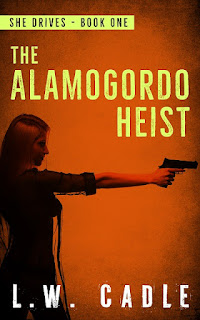
For a short time, $2.99 US (and comparable prices elsewhere)
A heist. A chase. A desperate gang holed up in a hideout.
Darla Doyle hates being poor. She didn't go to college. She doesn't have
a rich family. But she has a skill: driving. For five years, she has
been the getaway driver for several bank jobs, each netting her over
twenty thousand US dollars. It's not wealth, but it's enough to keep her
kids clothed.
Then a new bank job comes along. Great target. Good score. Well-planned. Well-executed by three people she's worked with before.
The plan is firing on all cylinders...right up until an armored car guard offers them more money than they'd every hoped for.
There's one thing Darla is certain of: If it sounds too good to be true....

If you're on my mailing list, you'll know about the launch, and I'll keep a low price on it for a week so my fans can give it a try for not much money, to see if they like it. It'll also be on Kindle Unlimited to read for free (I do get paid when you read!), so if you have that, or would like to try KU for a month for free, you'll be able to read it that way.
Stay tuned for the announcement and cover reveal.
Best to all of you -- Lou
